Azerbaijan Grand Prix 2026 Travel Guide: How to Plan Your F1 Trip to Baku
Got the tickets for the Azerbaijan Grand Prix 2026 but have no idea how to travel around the city? Where to stay? Where else to go? Well, we got you all covered in this one blog. Long before Formula 1 cars started clipping the walls of its Old City, Baku was busy being one of the odder success stories of the Caucasus: a city that struck oil in the 1800s, hosted Eurovision in 2012, and somehow still keeps a 12th-century watchtower standing next to buildings shaped like flames. It has its own gravity as a destination: Caspian views, a walled medieval quarter, a skyline that looks vaguely like it was designed on a dare. What the Grand Prix adds is a reason to time your visit around 51 laps of genuinely unhinged street racing. This Azerbaijan Grand Prix 2026 travel guide covers that race weekend in detail, along with everything else worth doing once the cars go quiet, because five nights in Baku is rarely just about the checkered flag.
Azerbaijan Grand Prix 2026 at a Glance
The Thursday-to-Saturday format is a genuine change from previous years. For the first time in the race's history, F1 Azerbaijan 2026 runs on a Saturday instead of a Sunday, moved to avoid clashing with Azerbaijan's National Day of Remembrance, observed on September 27.
What Makes the Azerbaijan Grand Prix Different From Other F1 Races?

Most street circuits (Monaco, Singapore) are famous for being slow and twisty. Baku is the opposite, and that contrast between a narrow, castle-lined section and one of the fastest straights on the calendar is really the whole appeal of this Azerbaijan F1 Grand Prix.
What sets this race apart:
- A street circuit through central Baku rather than a purpose-built track outside the city
- A long, fast main straight, one of the longest full-throttle stretches in F1
- A tight, technical Old City section running right past medieval walls
- A Caspian waterfront setting unlike anywhere else on the calendar
- Medieval architecture sitting directly alongside modern Baku
- Heavy-braking zones that produce some of the season's better overtaking chances
- The ability to combine a race weekend with a genuine city break
Baku City Circuit: A Street Track Through the City
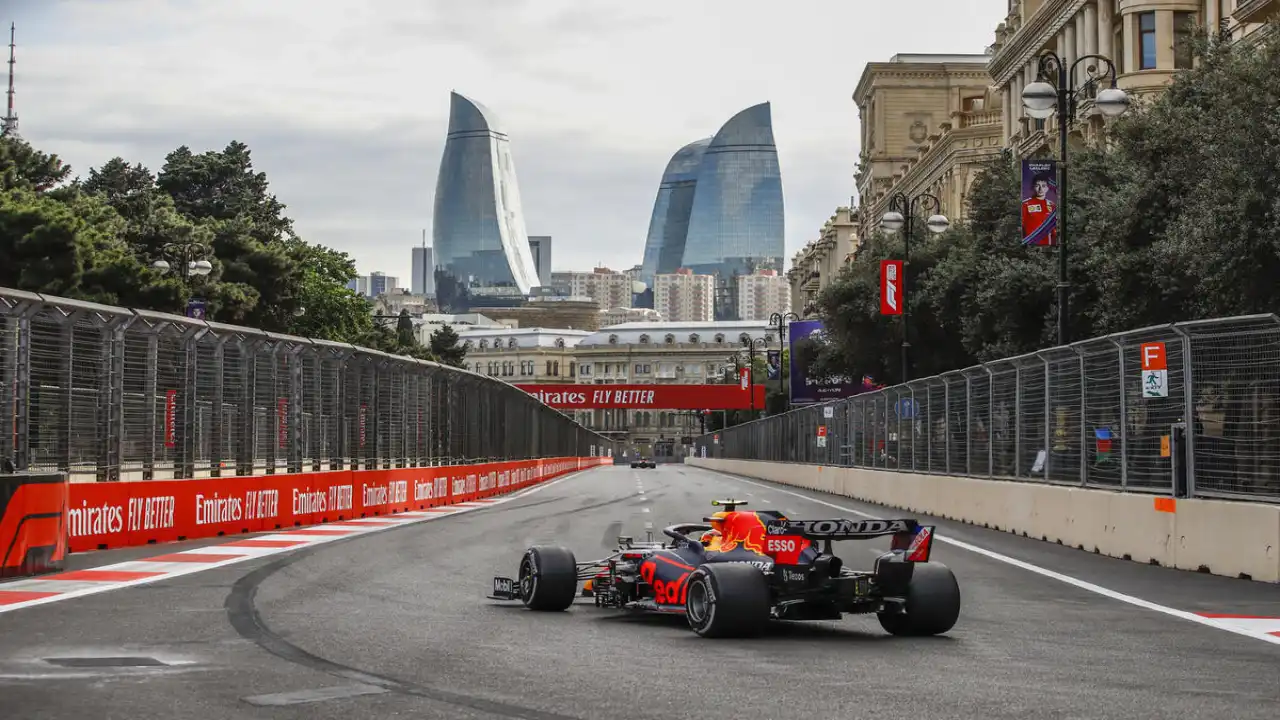
The circuit weaves through central Baku, running along the Caspian seafront, past the medieval walls of Icherisheher, and through a narrow, castle-adjacent section before opening into what is the longest full-throttle stretch on the F1 calendar, roughly 2.2 km from the final corner into Turn 1. Cars hit their top speeds of the season here, often over 340 km/h, right before braking hard into a tight right-hander. It's an odd, almost contradictory track: a medieval-street pinch point followed by a drag strip.
Why Baku Is an Interesting F1 Destination
Unlike Silverstone or Monza, where the circuit sits outside the city, Baku's track more or less is the city. You can watch practice from a café balcony on Nizami Street if you get the angle right, or walk from your hotel to a grandstand in fifteen minutes. Crowds here also tend to be smaller than at legacy European races, which makes movement easier, even during peak sessions.
Azerbaijan Grand Prix 2026 Schedule: What Happens Each Day?

Thursday, September 24: Practice Sessions
Free Practice 1 and Free Practice 2 run on Thursday, an unusual scheduling quirk specific to Baku's compressed weekend. Fans can generally expect two hour-long sessions with a break between them. Arriving thirty to forty minutes early is enough on practice days, since crowds are lighter than on qualifying or race day. Exact timings are usually confirmed by F1 around six to eight weeks before the event, so treat early listings as provisional. Once the session wraps, Nizami Street and the Old City are both good options for the evening.
Friday, September 25: Practice & Qualifying
Friday combines Free Practice 3 in the late morning with qualifying in the afternoon, split across Q1, Q2, and Q3. Qualifying at Baku is consistently unpredictable, since the walls sit close enough to punish small mistakes, and it's often more dramatic than the race itself. This is genuinely one of the better days to attend if ticket budgets are tight.
Saturday, September 26: Race Day
Gates typically open several hours before lights out, and queues at the main entrances near 28 May metro station can get long by mid-morning. The race runs 51 laps across the full 6.003 km lap, roughly 306 km total. Post-race, expect a slow, crowded exit, so it's worth deciding your route out before the chequered flag rather than after.
How many days is the Azerbaijan F1 weekend? Three, running Thursday to Saturday rather than the usual Friday-to-Sunday format most Grands Prix follow.
How to Get to Baku for the Azerbaijan Grand Prix

Flying to Baku
All international flights land at Heydar Aliyev International Airport (GYD), about 20 km northeast of the city centre. Most travelers connect through Dubai, Abu Dhabi, Doha, or Istanbul rather than flying nonstop, since direct India-Baku service has historically been limited and somewhat seasonal. It's worth checking closer to your travel dates, as airlines occasionally add temporary flights around major events like the Grand Prix.
From Heydar Aliyev International Airport to Central Baku
The AeroExpress bus service (route H1) runs to the city centre in around 30 to 40 minutes depending on traffic, and is by far the cheapest option. Taxis and private transfers take roughly the same time and cost more, but are worth it if you're arriving late at night or hauling luggage. During race week, expect airport traffic to be noticeably heavier than usual.
Travelling to Baku from India
This is genuinely one of the more overlooked parts of Baku, Azerbaijan Travel planning. Indian travelers usually fly out of Delhi or Mumbai, with one-stop options via the Gulf carriers being the most common route. Flight time, including a layover, generally runs eight to twelve hours. It's worth comparing a couple of Indian departure cities rather than assuming your nearest metro airport is cheapest, since fares vary by route and season. Booking two to three months ahead helps, since fares around race weekend tend to spike as hotel rooms and flights both get squeezed by race traffic. Before departure, double-check passport validity, visa status, and that your ticket or accreditation documents are printed and accessible.
Check out: Baku Trip: Discover the Best of Azerbaijan in 6 Days
Azerbaijan Visa Requirements for the 2026 F1 Grand Prix

Do Indians Need a Visa for Azerbaijan?
Yes. Indian passport holders need a visa to enter Azerbaijan for any purpose, including tourism. The standard route is the ASAN e-Visa, applied for online, a single-entry visa valid for stays of up to 30 days. Processing usually takes around three working days, though it's sensible to apply at least a week or two before departure rather than cutting it close.
Azerbaijan F1 Visa on Arrival
In 2023, 2024, and 2025, the Azerbaijani government issued a presidential decree temporarily allowing visa-on-arrival for anyone attending the Grand Prix, provided they could show an F1 ticket, proof of ticket purchase, or official event accreditation. This isn't a permanent policy; it's re-issued (or not) each year, and the exact eligibility window is usually announced only a few weeks before race weekend. Given the pattern of the last three years, something similar is reasonably likely for 2026, but nothing should be assumed. Applying for the standard e-Visa in advance remains the safer plan, and any race-specific arrangement should be treated as a bonus, not a backup plan you rely on at the airport.
Documents Required for the Visa
For the standard e-Visa: a passport valid for at least six months beyond your travel dates, a passport-sized photograph, proof of return or onward travel, and accommodation booking details. If a visa-on-arrival provision is confirmed for 2026, you'll additionally need your F1 ticket or purchase confirmation at immigration.
Important Visa Tips Before You Travel
Visa rules depend on nationality, so this guide's advice applies specifically to Indian passport holders. Print a physical copy of your e-Visa rather than relying solely on your phone at immigration, since queues move faster with paper in hand. Double-check your passport's expiry date well before applying, and verify current requirements on the official Azerbaijan e-visa portal closer to your travel dates, since these arrangements are reissued annually and subject to change.
Suggested Read: A Complete Travel Guide to Baku for First-Time Visitors
Where to Stay in Baku for the Azerbaijan Grand Prix
The important thing to know before booking: straight-line distance from the circuit isn't enough. During a street race, pedestrian routes and road closures can change how accessible a hotel actually is, more than the map suggests.
Icherisheher / Old City

Staying inside or right beside the walled Old City puts you within walking distance of part of the circuit itself, since the track runs directly along its outer walls. It's atmospheric, full of narrow lanes, small guesthouses, and the Maiden Tower, but can also mean noise from crowds and street closures during race week.
Nizami Street & Central Baku

The pedestrian shopping street and surrounding blocks offer the widest range of mid-range and upscale hotels, plus easy metro access to the circuit. This tends to be the most practical base for first-time visitors.
28 May Area

Named after the nearby metro station, this area sits close to one of the main circuit entrances and Fountains Square. It gets busy and slightly chaotic on race days, but the walk to the gates is short, which matters more than it sounds like it should when you're tired after a long day trackside.
How to Choose the Best Area for Your F1 Trip
If minimizing walking on race day is the priority, pick 28 May or the Old City. If you want quieter evenings and better restaurant options, Nizami Street or the area around Fountains Square works better, with a slightly longer but manageable walk or metro ride to the circuit.
Baku City Circuit Guide for First-Time F1 Visitors

Baku City Circuit Layout
The lap starts on a wide straight near the seafront, tightens through a technical middle sector around the castle walls, then opens into the long back straight before the final corner sequence. It's genuinely two different circuits stitched together, and that contrast is part of what makes it interesting to watch in person.
Key Sections of the Circuit
Turn 8 through Turn 12, the narrow castle section, is where overtaking is hardest and where cars sometimes clip the walls. Turn 16 into Turn 1, the long straight, is where DRS overtakes usually happen, and it's a genuinely good spot for photographs if you can get a grandstand seat there.
Where Is the Best Place to Watch F1 in Baku?
There's no single universal best spot; it depends on what you care about:
- For speed: grandstands along the main straight, where cars reach their top speeds of the year
- For braking and overtaking: Turn 1 and Turn 2, which catch both the braking zone and the tail end of the top-speed run
- For atmosphere: the Old City section around Turns 8 to 12, narrow and close to the medieval walls
- For first-time spectators: the Sahil Grandstand near the start-finish straight, which gives a broader view of the pit lane and podium area
Grandstands vs General Admission
General admission tickets let you roam between designated fan zones and often work out cheaper, but you won't get guaranteed seating anywhere. Grandstand tickets cost more and lock you into one section, though they usually come with better sightlines and shade, which matters more than people expect in Baku's late-September heat.
How to Get Around Baku During F1 Weekend
The circuit occupies central city streets, so normal taxi routes and pedestrian access can be affected during the race weekend, more than most first-time visitors expect.
Using the Baku Metro
The metro is fast, cheap, and generally the most reliable way to move around during race week, when road traffic near the circuit gets heavily restricted. Sahil and 28 May stations sit closest to the track.
Walking Around the Circuit Area
Much of central Baku near the circuit is genuinely walkable, and given the road closures, walking often ends up faster than driving anyway once you're within a kilometre or two of the track.
Taxis and Ride-Hailing
Taxis and apps like Bolt work fine outside race hours but get unreliable close to the circuit during session times, when road closures reroute traffic unpredictably. Budget extra time if you're relying on one to reach your hotel after the race.
Road Closures & Race-Weekend Restrictions
Several central roads around the circuit close from the morning of each session day through late evening. Local authorities publish closure maps closer to the event, and it's worth checking these the night before rather than assuming your usual walking route stays open.
Things to Do in Baku Besides Watching F1
Explore Baku's Old City

Icherisheher, a UNESCO World Heritage Site, holds the 12th-century Maiden Tower and the Shirvanshahs' Palace within its walls. It's compact enough to explore properly in half a day, even with the crowds of race week thickening the alleys.
Walk Along Baku Boulevard

This stretch of promenade runs along the Caspian seafront for several kilometres, past parks, cafés, and the Baku Ferris Wheel, and is a genuinely pleasant way to spend an evening after a day at the track.
Visit the Heydar Aliyev Center

Designed by Zaha Hadid, the building's curved white form is unlike anything else in the city and hosts rotating art and cultural exhibitions inside.
See the Flame Towers & Highland Park

The three flame-shaped skyscrapers dominate Baku's skyline and are lit up at night with a fire-like animation. Highland Park, reached by funicular, gives one of the better vantage points over the city and the Caspian.
Try Local Azerbaijani Food

Plov (saffron rice with meat or dried fruit), dolma, and qutab (thin stuffed flatbread) show up on most menus. Teze Bazar, the central market, is worth a visit for produce, spices, and a sense of daily Baku life away from the race crowds.
Suggested Read: Baku Food Tours & Wine Tasting Experiences
How Many Days Do You Need for the Azerbaijan Grand Prix?
Travel Junky's own Baku tour package range runs from a compact 4-day/3-night trip up to a fuller 7-day/6-night version, and that spread is a reasonable guide for planning race-weekend length too.
3-Night F1 Trip
Covers the race weekend itself, arriving Thursday and leaving after the Saturday race, but leaves little time for sightseeing beyond quick evening walks.
4-Night Baku F1 Trip
Adds a buffer day for jet lag recovery and one solid day of sightseeing, generally the more comfortable minimum.
5-Night F1 & Baku Holiday
This is the sweet spot for most travelers, roughly matching the shorter end of Travel Junky's 5D/4N packages, allowing a proper day in the Old City, an evening at Highland Park, and still leaving room to rest between sessions.
Extending Your Azerbaijan Trip Beyond Baku
If race weekend isn't the only thing on the agenda, the longer 6D/5N and 7D/6N packages point to where to spend the extra nights. Gabala, in the foothills, is a common one to two-night add-on with cable car rides over the highlands. Shahdag, further into the mountains, works as a two-night extension for cooler weather and more scenic drives. Closer to the city, Absheron Peninsula covers the fire temples and the Yanar Dag burning mountain in a single day, and Gobustan's mud volcanoes and prehistoric rock carvings make for another easy day trip from Baku. Any of these pair naturally with a race-weekend trip if you're staying five nights or more.
Suggested Azerbaijan Grand Prix 2026 Itinerary
Day 1: Arrive in Baku & Explore the City — Land, check in, and take an easy walk along Baku Boulevard to adjust before the busier days ahead.
Day 2: Baku Sightseeing & F1 Weekend — Full day in Icherisheher and around Fountains Square, picking up circuit-side wristbands or accreditation if needed before Thursday's sessions begin.
Day 3: Practice Sessions & Baku — Attend Thursday's Free Practice 1 and 2, then head to Nizami Street for dinner once the crowds thin out.
Day 4: Qualifying & Evening in Baku — Watch Friday's qualifying session, then catch sunset from Highland Park before the Flame Towers light up.
Day 5: Azerbaijan Grand Prix Race Day — Arrive early at the circuit, watch the full 51-lap race, and expect a slow exit through the crowds afterward.
Day 6: Departure or Azerbaijan Extension — Fly out, or use the extra day for a Gobustan or Absheron day trip, both standard add-ons on Travel Junky's longer Baku itineraries.
What to Pack for the Azerbaijan Grand Prix
F1 Race-Day Essentials
Earplugs (genuinely necessary, F1 cars are loud), a portable phone charger, sunscreen, and a refillable water bottle, since late September in Baku still runs warm during the day.
What to Wear to the Circuit
Comfortable, broken-in shoes matter more than anything else, given how much walking a race weekend involves. Light, breathable layers work well for daytime, with something warmer for evening sessions once the sea breeze picks up.
What Can You Take Inside the Baku F1 Circuit?
Small bags are generally permitted, but check current restrictions on cameras with detachable lenses, umbrellas, and outside food or drink, since these change slightly year to year and are published on the official ticketing site closer to the event.
Azerbaijan Grand Prix Tips for First-Time Visitors
- Don't judge hotel convenience by map distance alone — road closures change what's actually walkable during race week.
- Check race-day transport changes — metro and bus routes near the circuit often adjust their schedules on session days.
- Keep your F1 ticket accessible — whether digital or printed, keep it somewhere quick to reach at entry gates.
- Arrive early at the circuit — security lines lengthen quickly in the hour before gates close, particularly on race day.
- Plan your post-race transport — post-race exits are genuinely one of the slower parts of the day, so decide your route out before the chequered flag.
- Keep important travel documents offline — save copies of your visa, hotel booking, and ticket confirmations somewhere that doesn't need internet access.
How Much Does an Azerbaijan Grand Prix Trip Cost?
Travel Junky's land-only Baku packages (hotel, breakfast, transfers, sightseeing) exclude flights, F1 tickets, and visa fees, so those need budgeting separately.
How Much Does It Cost to Attend F1 in Baku From India?
A five-night trip combining a mid-range land package (roughly ₹35,000 to ₹40,000 per person) with flights and a general admission F1 ticket typically lands somewhere in the ₹1.2 to ₹2 lakh range per person, excluding shopping and premium grandstand upgrades.
Azerbaijan Grand Prix 2026 Travel Checklist
☐ Check passport validity (at least 6 months beyond travel dates)
☐ Check Azerbaijan visa requirements and apply for the e-Visa
☐ Book flights
☐ Buy F1 tickets through an official source
☐ Book central accommodation
☐ Arrange airport transfer
☐ Download and save tickets and visa documents offline
☐ Check circuit entry rules for bags, cameras, and outside food
☐ Confirm the current race schedule closer to the date
☐ Plan sightseeing around free time between sessions
☐ Check weather before departure
☐ Save emergency and hotel contact information offline
☐ Keep race-day transport plans flexible
Note: race schedules, ticket rules, transport restrictions, and venue policies for the 2026 Azerbaijan Grand Prix are subject to change closer to the event. It's worth rechecking official sources before travelling.
Plan Your Azerbaijan F1 Trip with Travel Junky
Travel Junky puts together Baku tour package options starting around ₹31,666 per person for a compact 4D/3N trip and extending up to 7D/6N itineraries that fold in Gabala, Shahdag, Absheron, and Gobustan alongside Baku itself, covering flights, centrally located hotels, and circuit-adjacent stays for race weekend. For anyone weighing up a first Grand Prix abroad, that kind of groundwork tends to matter more than it looks like it would from the outside.
Final Thoughts
Baku rewards travelers who treat the Grand Prix as one part of a longer trip rather than the entire point of it. The city has genuine depth beyond the circuit, from its walled Old City to its Caspian seafront, and pairing race weekend with even one or two extra days in Gabala, Shahdag, or Gobustan makes the whole trip feel less rushed and considerably more worthwhile. So, if you are an F1 fan and you enjoy travelling, then this Azerbaijan Grand Prix 2026 is a win-win for you!
Azerbaijan Grand Prix 2026 Frequently Asked Questions
When is the Azerbaijan Grand Prix 2026?
September 24 to 26, 2026, with the race on Saturday, September 26.
Where is the Azerbaijan Grand Prix held?
At the Baku City Circuit in central Baku, Azerbaijan.
Is the Azerbaijan Grand Prix on Saturday or Sunday?
Saturday, for the first time in the race's history, moved from its usual Sunday slot due to a national day of remembrance.
What airport should I fly to for Baku F1?
Heydar Aliyev International Airport (GYD), about 20 km from the city centre.
Do Indians need a visa for the Azerbaijan Grand Prix?
Yes, Indian citizens need a visa, typically the ASAN e-Visa, applied for online before travel.
Can F1 ticket holders get a visa on arrival in Azerbaijan?
In recent years (2023 to 2025), a temporary decree allowed visa-on-arrival for ticket holders during race season, but this is reissued annually and shouldn't be assumed without confirmation closer to the 2026 event.
Where should I stay for the Azerbaijan Grand Prix?
Nizami Street or central Baku for convenience, the Old City for atmosphere, or the 28 May area for proximity to the circuit gates.
How do I get to Baku City Circuit?
By metro to Sahil or 28 May station, or on foot if staying centrally, since much of the surrounding area closes to vehicle traffic during sessions.
How many days should I spend in Baku for F1?
Four to five nights covers the race weekend comfortably, with time left for sightseeing.
What should I wear to the Azerbaijan Grand Prix?
Comfortable walking shoes and breathable layers for daytime heat, with something warmer for evening sessions.
What can I take inside the F1 circuit?
Small bags are usually fine, but check current-year restrictions on cameras, umbrellas, and outside food before travel day.
Is Baku a good destination for a first F1 race?
Yes. Smaller crowds than legacy European races, a walkable central circuit, and a genuinely distinct street track make it an approachable first Grand Prix.