Why Meghalaya’s Living Root Bridges Are More Than a Tourist Attraction
India is a land of wonders, and so much of it still awaits discovery, especially in the Northeast. Every corner of this region has a story to tell, and this time, we’re unwrapping Meghalaya Tourism.
The name Meghalaya means “the abode of clouds,” and anyone who has seen its mist-covered hills can understand why. We often admire the state for its rolling hills, dramatic skies, cascading waterfalls, and endless stretches of green. But what if we looked a little closer, beneath the scenery itself? That’s where another of Meghalaya’s wonders begins: its roots.
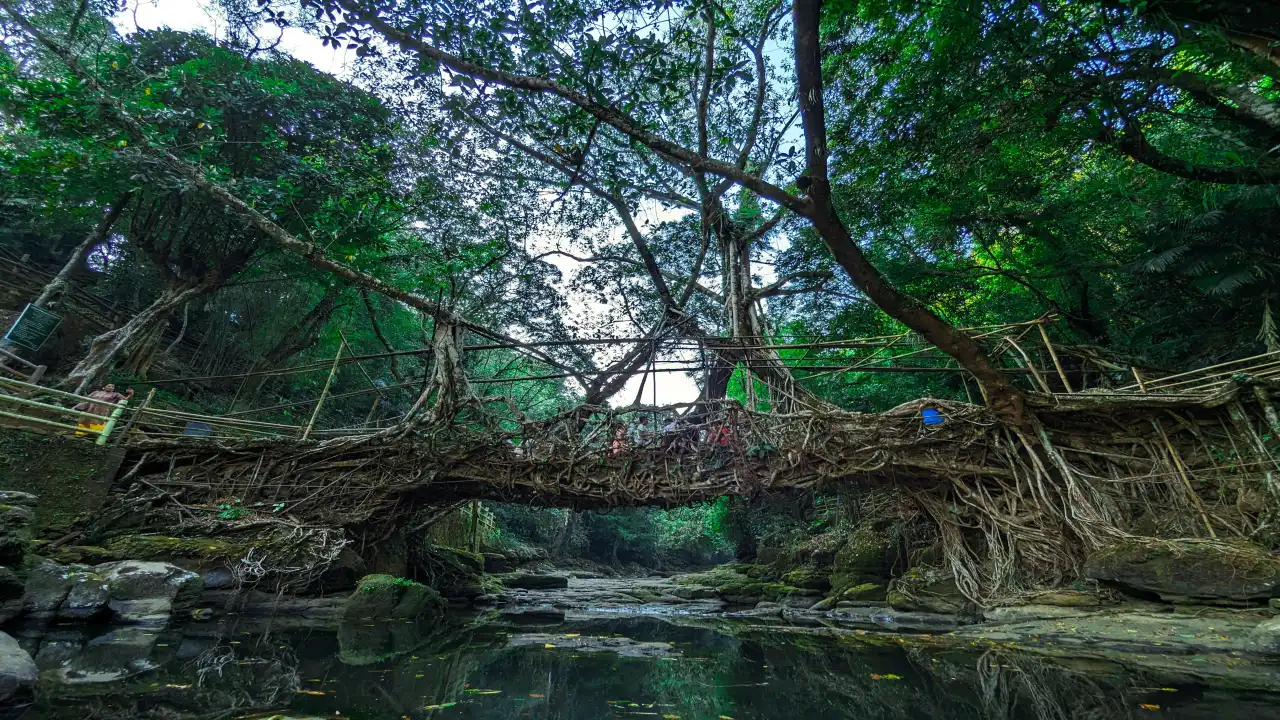
Most bridges are considered complete the day they open. Meghalaya’s living root bridges are different. Shaped from the aerial roots of rubber fig trees (Ficus elastica) and carefully guided by people over many years, these remarkable crossings continue to grow and develop long after they first become usable. They are more than picturesque landmarks. They reflect generations of Khasi and Jaintia knowledge, offer practical ways to cross streams and difficult terrain, and demonstrate a relationship with nature built on patience, skill, and continuous care.
What Are Meghalaya’s Living Root Bridges, and How Do They Grow?
Living root bridges are crossings grown from the aerial roots of rubber fig trees and trained across streams and gaps by Khasi and Jaintia communities in the hills of Meghalaya. Nobody assembles them from finished parts. The tree is the material, and it keeps growing after the bridge is in use.
It starts with a tree on a riverbank. Its roots are steered across the gap, often with bamboo or other temporary supports guiding the way, until they reach the far side and take hold in the soil. Then comes the waiting. Roots thicken, twine around each other and fuse where they touch, and that takes years. Not every bridge follows the same method, and not every one matures on the same schedule.
Even once people can walk across, the work goes on. Roots get added, tucked in, redirected. So what separates a living root bridge from an ordinary one? Mostly time, and the fact that it is never handed over as a finished product.
The Indigenous Engineering Behind a Bridge That Keeps Growing
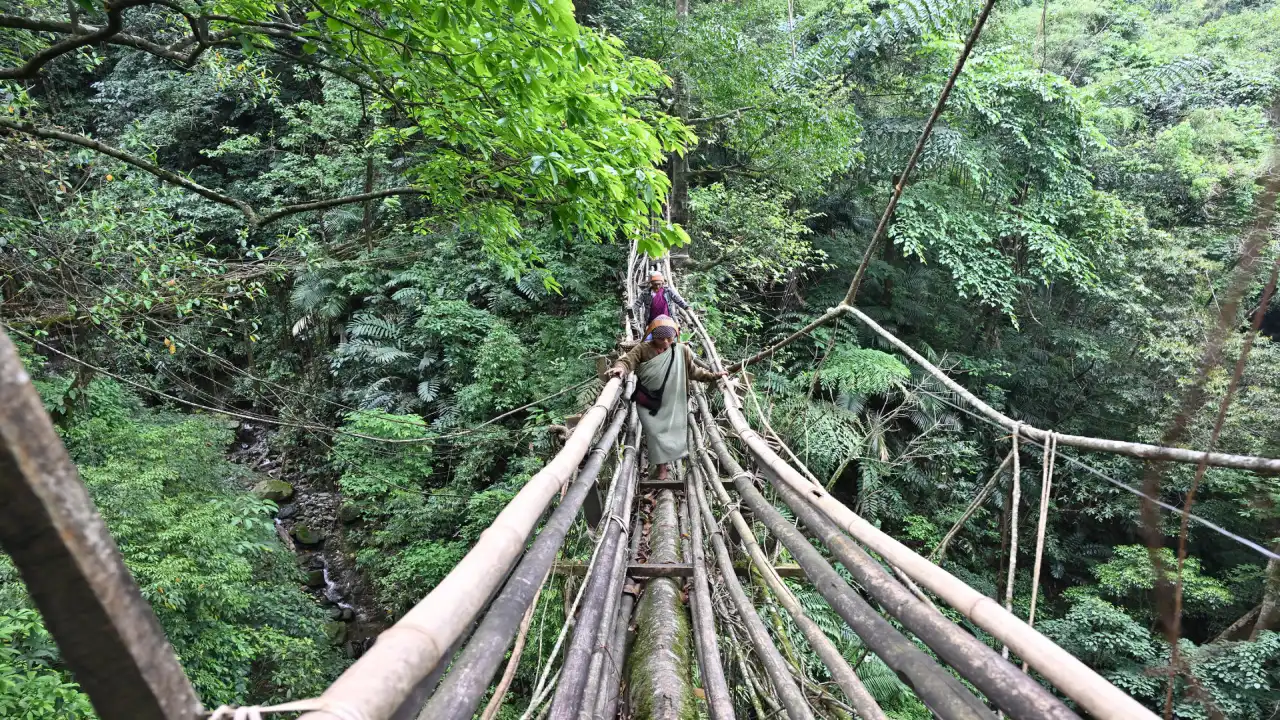
Guiding Roots into a Structure
The route is chosen, the roots are directed along it, and someone has to return season after season to nudge them further. This is deliberate, skilled work. Spontaneous? Hardly.
Strength That Develops Over Time
As roots grow and intertwine, they form a connected structure. How a particular bridge performs depends on its maturity, the condition of its roots, the site and the care it receives. A young bridge and an old one are very different things to stand on.
Engineering for the Landscape
Steep slopes, fast streams, dense vegetation and some of the heaviest rainfall anywhere (the hills around Sohra and Mawsynram are among the wettest places on earth). A structure that grows in such a setting, and tightens its grip as it ages, suits the place it comes from.
Conventional construction tries to finish quickly. A root bridge asks for a long relationship between the people and the material.
The People Behind the Bridges
Take the people out of the story, and the bridges are just trees. The knowledge belongs to Khasi and Jaintia communities, and it lives in practice: knowing which trees to use, how roots behave on a particular slope, when to guide and when to wait. Skills like these are passed between generations, usually by working beside someone who already knows.
The bridges also sit within village life, linking settlements, fields and paths. Outsiders have written about them since at least the nineteenth century, though no exact starting date for the tradition can be pinned down. In 2022, India put the Living Root Bridge Cultural Landscapes of Meghalaya forward for UNESCO World Heritage status through its tentative list, recognition that sits comfortably within Meghalaya Cultural Heritage as a whole.
Preserving this means protecting the knowledge and the practice, not just the landmark. These bridges are not nature doing something extraordinary on its own. They show what careful observation and long collaboration with living trees can achieve.
Which Living Root Bridges Should You Visit, and How Do You Reach Them?
Four bridges cover most itineraries. They range from a long descent into a valley to a short walk from the road.
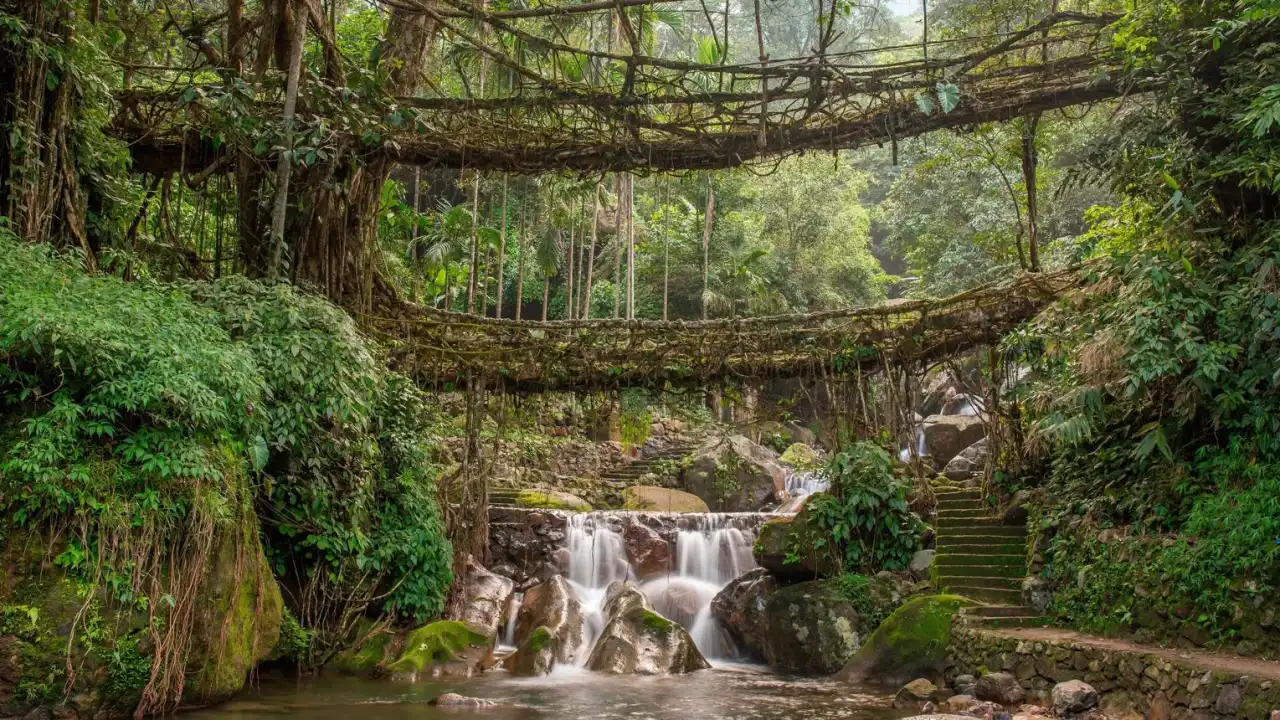
Nongriat’s Double-Decker: The One You Earn with Your Knees
Location: Nongriat village, East Khasi Hills, about 15 km from Sohra (Cherrapunji). Shillong is roughly 65 km away by road, and Guwahati airport is about 179 km.
How to reach: Drive from Sohra to Tyrna village, a taxi ride of 30 to 45 minutes. Vehicles stop there. From Tyrna, the trail drops roughly 3,000 stone steps into the valley, and every one of them has to be climbed back up. A local guide is advisable, and a reasonable level of fitness is needed.
Speciality: Two tiers of living root over a stream, the best-known root bridge in the world. A smaller single-root bridge sits just before the village, and Rainbow Falls lies about an hour’s walk beyond the main bridge.
Best time: October to March for drier steps. Monsoon rain makes the trail slippery.
Rangthylliang–Mawkyrnot: Longest of Them All
Location: Rangthylliang and Mawkyrnot villages near Pynursla, East Khasi Hills. Pynursla town is about 50 km from Shillong.
How to reach: Hire a cab or drive to Pynursla, then continue to Rangthylliang, where the guided root bridge trek begins. The trek ends at Mawkyrnot, and Meghalaya Tourism describes it as a one-day outing, with an overnight stay possible. About 1,500 steps lead down to the longest bridge.
Speciality: At around 53 metres, this is regarded as the longest known living root bridge. Two rubber fig trees on opposite banks of a river form it. The guided trek passes several more bridges and is led by a local root bridge specialist.
Riwai: A Root Bridge Without the Marathon
Location: Riwai village, a few kilometres before Mawlynnong, roughly 75 to 80 km from Shillong (around three hours by road).
How to reach: Drive to Riwai, park, and walk. The path to the bridge is short, about 10 to 15 minutes each way, with some steps. A small entry fee is collected locally.
Speciality: Easy access. Two rubber fig trees on opposite banks of the stream form it, and visitors can cross it and view it from the water’s edge. Pairing it with Mawlynnong, a village known for its cleanliness, makes a comfortable day trip.
Nohwet: The Quiet Neighbour
Location: Nohwet village, about 2 km from Mawlynnong.
How to reach: Drive to Nohwet and take a short hike to the bridge.
Speciality: A quieter alternative near Mawlynnong, often listed among the more accessible root bridges in the region, and a natural add-on to the Riwai visit.
Short on time or energy? Riwai or Nohwet. Want the famous one and willing to earn it? Nongriat. Want something almost nobody photographs? Rangthylliang.
When Tourism Meets Living Heritage: Benefits, Pressures, and Responsibility
Tourism can help a place like this, and it can strain it.
Which side wins depends on how tourism is managed and how much control local communities keep over the experience.
For visitors, a few habits matter:
- Follow local guidance and stay on designated paths.
- Do not pull, damage, or climb on fragile roots.
- Carry rubbish back out and dispose of it responsibly.
- Ask before photographing residents or entering private spaces.
- Respect guides, community rules and access restrictions.
Pro tip: hire a local guide from the village. Beyond the practical help on the trail, it keeps some of the benefit where it belongs.
What the World Can Learn from Meghalaya’s Living Root Bridges
Infrastructure can evolve. A structure does not have to be a finished product. It can develop through continued growth and care.
Local knowledge has practical value. Generations of observation produce solutions fitted to specific landscapes and needs.
Sustainability requires stewardship. Material choice matters, but so do maintenance, conditions, community participation, and responsible use.
None of this means root bridges can be copied everywhere. The point is wider than the technique: local knowledge can change how we think about building.
A Different Way to Think About Building
A bridge that is never finished sounds like a flaw until you see one. Meghalaya’s living root bridges bring together indigenous engineering, community knowledge, practical infrastructure, and environmental awareness in a single crossing. Their greatest significance is not how unusual they look, but the generations of knowledge and care behind them. For travellers who want to see them properly, Travel Junky’s northeast tour packages are a place to start.
Frequently Asked Questions About Meghalaya’s Living Root Bridges
What are Meghalaya’s living root bridges made of?
They are formed from the aerial roots of rubber fig trees (Ficus elastica), which are guided and trained over time to create usable crossings.
How long does it take to grow a living root bridge?
Many years, sometimes decades, before it becomes a mature, usable structure. The timeline depends on the site, root growth, guiding techniques, and maintenance.
Which communities developed Meghalaya’s living root bridges?
The tradition is associated with Khasi and Jaintia communities, whose knowledge of local trees and landscapes has made it possible to develop and maintain these structures.
Where can you see living root bridges in Meghalaya?
Nongriat, near Sohra (Cherrapunji), is home to the famous Double-Decker Living Root Bridge. Other living root bridges are found in parts of the Khasi and Jaintia Hills, and anyone planning a trip around living root bridges in Meghalaya has several to choose from.
Are living root bridges environmentally sustainable?
They show nature-based engineering and locally adapted design. How sustainable they are depends on maintenance, ecosystem conditions, and how the surrounding area is managed.